- Presentation
- Research
- REGARN : Regulatory non-coding RNAs in root plasticity
- ChromD : Chromosome Dynamics
- SILAB : Signaling pathways regulating Legume root system Architecture through Beneficial bacteria
- Qlab : Plant Quantitative Genomics and Epigenomics
- FLOCAD : Flower and Carpel Development
- CCARS : Climate Change & Redox Signaling
- STRESS : Stress signaling
- MetaboActions : Signaling, regulation and metabolic interactions
- DPHYS : Department Physiology and signaling
- GDYNPATH: Genome Dynamics and Pathogen Resistance
- SYMUNITY: Symbiosis and Immunity
- OGE: Organellar gene expression
- GNet : Genomic Networks
- GUILLOTIN Lab
- Teaching
- Platforms
- Databases


Redox regulation of plant HDACs in response to climate change
Kick-off REPHARE project : Redox regulation of plant HDACs in response to climate change
Histone deacetylases (HDACs) are key epigenetic regulators but how their activity is regulated remains largely unknown. The ANR project REPHARE that just started (the kick-off meeting took place on 6 February 2020) is designed to study regulation of posttranslational modifications, subcellular localization, enzymatic activity and epigenetic function of Arabidopsis HDACs in response to cellular redox state changes under elevated ambient temperatures. This project coordinated by Dao-Xiu Zhou from IPS2 also involves LGDP (ReDAC team, Univ. Perpignan) combining expertise in plant epigenetics and redox modifications/regulations.
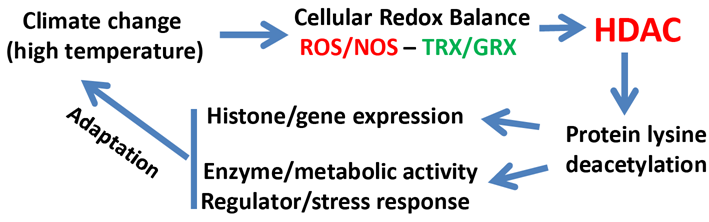
Working hypothesis of REPHARE project.
Elevated ambient temperatures alter cellular redox Balance (ROS / NOS) and regulators (such as TRX / GRX) leading to redox modification changes of HDACs to regulate gene expression and metabolic activity, thereby enhancing stress plant adaptation.