- Presentation
- Research
- REGARN : Regulatory non-coding RNAs in root plasticity
- ChromD : Chromosome Dynamics
- SILAB : Signaling pathways regulating Legume root system Architecture through Beneficial bacteria
- Qlab : Plant Quantitative Genomics and Epigenomics
- FLOCAD : Flower and Carpel Development
- CCARS : Climate Change & Redox Signaling
- STRESS : Stress signaling
- MetaboActions : Signaling, regulation and metabolic interactions
- DPHYS : Department Physiology and signaling
- GDYNPATH: Genome Dynamics and Pathogen Resistance
- SYMUNITY: Symbiosis and Immunity
- OGE: Organellar gene expression
- GNet : Genomic Networks
- GUILLOTIN Lab
- Teaching
- Platforms
- Databases


New roles for MAP Kinases in nitrate perception
Nitrate activates an MKK3-dependent MAPK module via NLP transcription factors in Arabidopsis
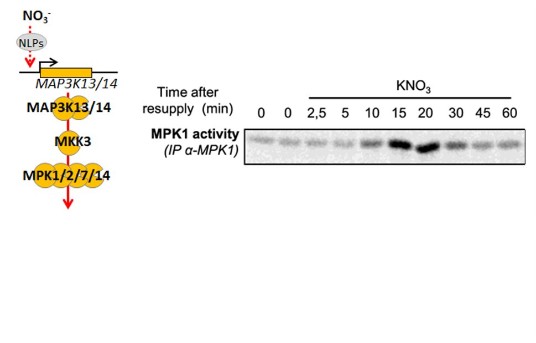
As part of a collaborative study between the NUTS team from the Institute Jean-Pierre Bourgin (IJPB) and STRESS team from the Institute of Plant Sciences Paris-Saclay (IPS2), recently published in The Plant Journal, scientists have discovered a new signalling pathway that helps plants to acquire nitrogen, a nutrient vital for growth. The study reveals that nitrate, a form of nitrogen taken from the soil, triggers a cascade of molecular events involving specific proteins called MAP kinases. This cascade is initiated by the NLP (NIN-Like Protein) transcription factors and involves MAP3K13 and MAP3K14, two kinases whose role was poorly understood until recently. This discovery adds to our knowledge on plant adaptation to nutrient availability and could lead to strategies for improving nitrogen use efficiency in crops, reducing the use of fertilizers and promoting sustainable agriculture.
10/03/2025