- Presentation
- Research
- REGARN : Regulatory non-coding RNAs in root plasticity
- ChromD : Chromosome Dynamics
- SILAB : Signaling pathways regulating Legume root system Architecture through Beneficial bacteria
- Qlab : Plant Quantitative Genomics and Epigenomics
- FLOCAD : Flower and Carpel Development
- CCARS : Climate Change & Redox Signaling
- STRESS : Stress signaling
- MetaboActions : Signaling, regulation and metabolic interactions
- DPHYS : Department Physiology and signaling
- GDYNPATH: Genome Dynamics and Pathogen Resistance
- SYMUNITY: Symbiosis and Immunity
- OGE: Organellar gene expression
- GNet : Genomic Networks
- GUILLOTIN Lab
- Teaching
- Platforms
- Databases


Projet ANR : PATHOSYM
Understanding the frontiers between pathogenicity and legume-rhizobia symbiosis
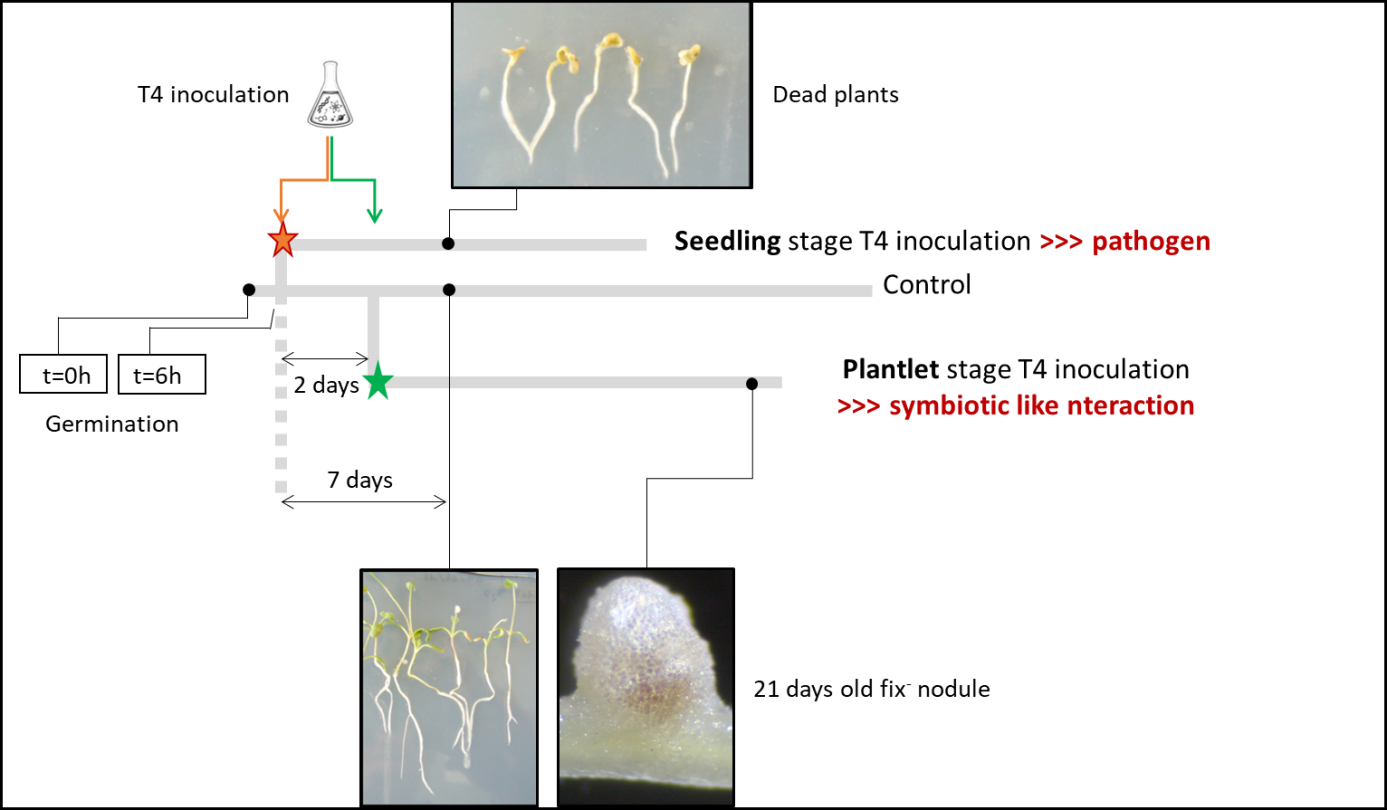
Legumes can establish a nitrogen-fixing symbiosis with rhizobia to offset the plant's need for nitrogen fertilizer. This interaction results in the formation of root nodules where rhizobia fix atmospheric nitrogen for the plant. Nodules can also be induced by non-fixing rhizobia and/or be colonized by non-rhizobia bacteria. We have isolated from nodules an atypical bacterium (Ensifer adhaerens T4) that behaves as a pathogen or induces nodules in Medicago truncatula.
The ANR project PATHOSYM coordinated by Pascal Ratet (Institut des Sciences des Plantes - Paris-Saclay - IPS2, CNRS/INRAE/UPSaclay/UEVE, Gif-sur-Yvette) in collaboration with B. Gourion and F. Vailleau (LIPME, INRAE, Toulouse) and the startup iMEAN aims to study this original interaction. During this project, we will describe the pathogen and symbiotic-like interactions of this system, and then by integrating genomic, transcriptomic, proteomic and physiological data of the strain, build a model of T4 genome function. We will also study the response of the plant during symbiotic-like and pathogenic interactions with the T4 strain or mutant derivatives. The PATHOSYM project thus aims to describe the molecular basis of T4-M. truncatula interactions to understand the contrasting behaviors of T4 and to see how the plant differentiates pathogens and symbionts.
13/01/2022