- Presentation
- Research
- REGARN : Regulatory non-coding RNAs in root plasticity
- ChromD : Chromosome Dynamics
- SILAB : Signaling pathways regulating Legume root system Architecture through Beneficial bacteria
- Qlab : Plant Quantitative Genomics and Epigenomics
- FLOCAD : Flower and Carpel Development
- CCARS : Climate Change & Redox Signaling
- STRESS : Stress signaling
- MetaboActions : Signaling, regulation and metabolic interactions
- DPHYS : Department Physiology and signaling
- GDYNPATH: Genome Dynamics and Pathogen Resistance
- SYMUNITY: Symbiosis and Immunity
- OGE: Organellar gene expression
- GNet : Genomic Networks
- GUILLOTIN Lab
- Teaching
- Platforms
- Databases


The Carbon Footprint of IPS2
The Carbon Footprint of IPS2
Research, like most modern human activities, is highly dependent, directly or indirectly, on fossil fuels. In a world where these energies are limited and associated with high greenhouse gas emissions strongly disrupting the climate, it is called upon to reinvent itself to reduce this dependence.
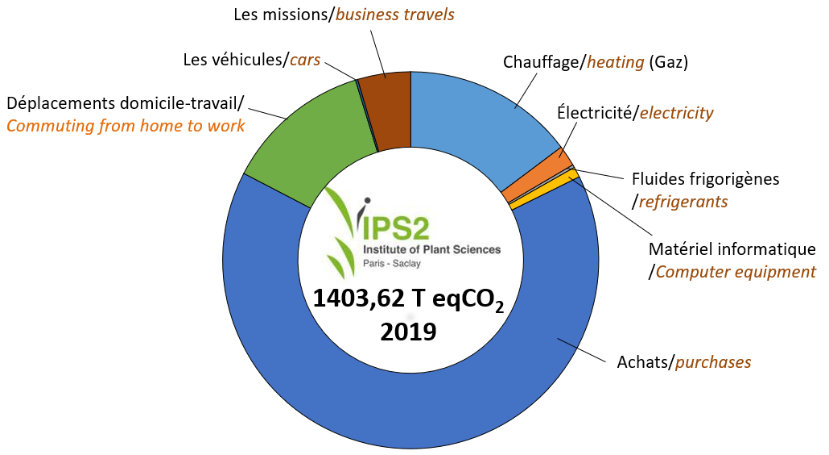
The Sustainable Research Activity (ARS) group of IPS2 presented in plenary meeting the results of its quantitative analyses of greenhouse gases emitted by the activity of the institute. This work was carried out using the GES1point5 tool from Labo1point5. In 2019, a year not affected by the Covid-19 pandemic, IPS2 activities regenerated in total 1,403 tons of CO2 equivalent, i.e. 18 tons per publication. 17% of these emissions come from the consumption of energy and in particular gas for heating the building 630, 13% from travel between homes and the laboratory, and 5% from professional travels often by plane. But the strongest item, by far, corresponds to the purchase of materials and consumables (> 60%). Based on these observations, the institute is now embarking on a period of thinking on how to reduce its environmental impact…
06/02/2023