- Presentation
- Research
- REGARN : Regulatory non-coding RNAs in root plasticity
- ChromD : Chromosome Dynamics
- SILAB : Signaling pathways regulating Legume root system Architecture through Beneficial bacteria
- Qlab : Plant Quantitative Genomics and Epigenomics
- FLOCAD : Flower and Carpel Development
- CCARS : Climate Change & Redox Signaling
- STRESS : Stress signaling
- MetaboActions : Signaling, regulation and metabolic interactions
- DPHYS : Department Physiology and signaling
- GDYNPATH: Genome Dynamics and Pathogen Resistance
- SYMUNITY: Symbiosis and Immunity
- OGE: Organellar gene expression
- GNet : Genomic Networks
- GUILLOTIN Lab
- Teaching
- Platforms
- Databases


Global transcription repression in plants
Identification of a global mechanism of transcription repression in the model plant Arabidopsis thaliana.
In an article published in PNAS and coordinated by Cécile Raynaud, the Chromosome Dynamics team at the Paris-Saclay Plant Science Institute highlights the existence of a global mechanism of transcriptional repression in the model plant Arabidopsis thaliana.
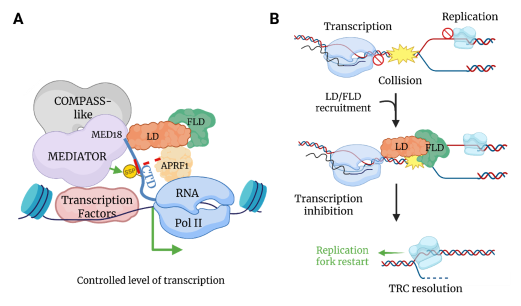
Through a genetic screen, the researchers showed that the LUMINIDEPENDENS (LD) protein is involved in the response to replicative stress. Analysis of its targets, performed by combining chromatin immunoprecipitation and spike-in normalized transcriptomic approaches, reveals that LD acts as a negative regulator of transcription at the genome level.
The study of its protein partners, performed in collaboration with the group of Geert De Jaeger (VIB, Gent), suggests that LD modulates transcription through various mechanisms, including histone modification, RNA polymerase II phosphorylation, and its recruitment to chromatin by the Mediator complex.
LD thus appears to act as a global regulator of transcription, whose role in the response to replicative stress could be explained by a reduction in transcription-replication conflicts, which are major sources of replicative stress and genomic instability.
09/01/2026