- Presentation
- Research
- REGARN : Regulatory non-coding RNAs in root plasticity
- ChromD : Chromosome Dynamics
- SILAB : Signaling pathways regulating Legume root system Architecture through Beneficial bacteria
- Qlab : Plant Quantitative Genomics and Epigenomics
- FLOCAD : Flower and Carpel Development
- CCARS : Climate Change & Redox Signaling
- STRESS : Stress signaling
- MetaboActions : Signaling, regulation and metabolic interactions
- DPHYS : Department Physiology and signaling
- GDYNPATH: Genome Dynamics and Pathogen Resistance
- SYMUNITY: Symbiosis and Immunity
- OGE: Organellar gene expression
- GNet : Genomic Networks
- GUILLOTIN Lab
- Teaching
- Platforms
- Databases


Signaling peptides and endosymbioses
Signaling peptides at the crossroad of plant root endosymbioses
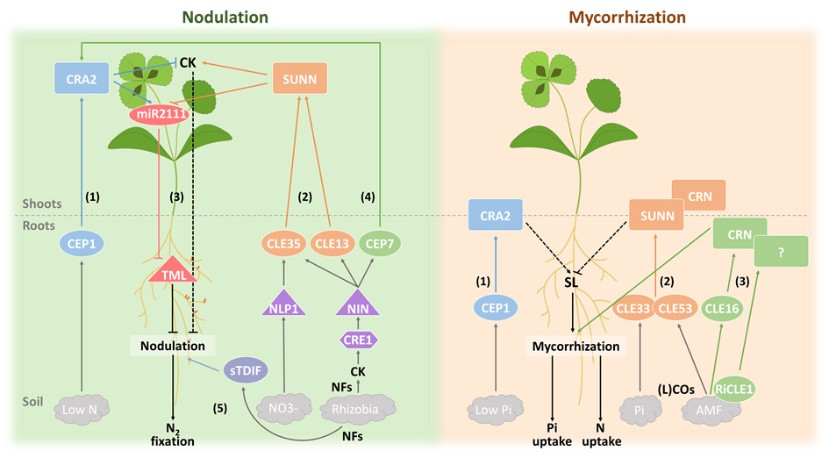
In the heterogeneous and fluctuating environments in which plants grow, they must efficiently acquire essential nutrients to sustain growth and development. Root endosymbioses, including nitrogen-fixing nodulation and arbuscular endomycorrhization, allow plants to cope with limitations of soil mineral nutrients, such as nitrogen and phosphorus. In a review published in Trends in Plant Sciences by the F. Frugier’s SILEG team, researchers summarized our current knowledge on secreted signaling peptides that recently emerged as key regulators of these two evolutionary-related endosymbioses. This includes the C-TERMINALLY ENCODED PEPTIDES (CEPs) and the CLAVATA3 / EMBRYO SURROUNDING REGION-RELATED (CLE) peptides. By putting into perspective the intricate relationships between these signaling peptides and nutrient dynamics, this review highlights their potential as targets to better coordinate and prioritize plant nutrition in limiting environments.
05/02/2026