- Presentation
- Research
- REGARN : Regulatory non-coding RNAs in root plasticity
- ChromD : Chromosome Dynamics
- SILAB : Signaling pathways regulating Legume root system Architecture through Beneficial bacteria
- Qlab : Plant Quantitative Genomics and Epigenomics
- FLOCAD : Flower and Carpel Development
- CCARS : Climate Change & Redox Signaling
- STRESS : Stress signaling
- MetaboActions : Signaling, regulation and metabolic interactions
- DPHYS : Department Physiology and signaling
- GDYNPATH: Genome Dynamics and Pathogen Resistance
- SYMUNITY: Symbiosis and Immunity
- OGE: Organellar gene expression
- GNet : Genomic Networks
- GUILLOTIN Lab
- Teaching
- Platforms
- Databases


Evolution of the sclareol biosynthesis pathway in clary sage
Clary sage genome reveals the evolutionary origin of a valuable natural compound
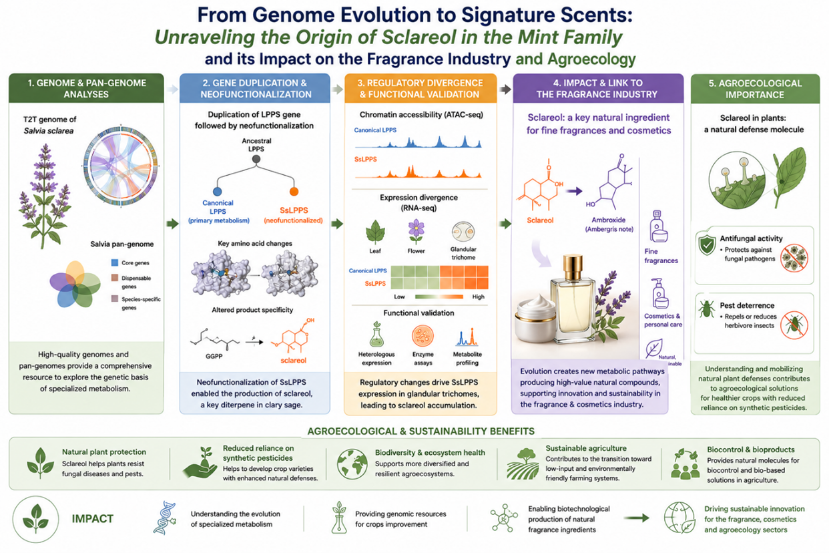
An international team led by researchers from the FLOCAD team of the Institute of Plant Sciences of Paris-Saclay (IPS2, INRAE/CNRS/University Paris-Saclay) has uncovered the genetic and evolutionary mechanisms responsible for the production of sclareol, a natural diterpene with antifungal properties and major industrial value. Published in Nature Communications, the study reveals how evolution generated a specialized metabolic pathway that enables clary sage (Salvia sclarea) to produce this remarkable molecule.
Clary sage is widely cultivated for its aromatic properties and is one of the main natural sources of sclareol. In plants, sclareol contributes to defense against pathogens. It is also highly valued by the fragrance industry as the precursor of ambroxide, a key ingredient used in many high-end perfumes for its characteristic amber notes. Despite its importance, the evolutionary origin of sclareol production remained unknown.To address this question, the IPS2 researchers generated a complete telomere-to-telomere (T2T) genome assembly of clary sage and constructed a genus-wide pan-genome of Salvia.
Their analyses revealed that a recent duplication of an ancestral diterpene synthase gene gave rise to a second copy that progressively acquired a different enzymatic activity. This neofunctionalization enabled the synthesis of labda-13-en-8-ol diphosphate (LPP), the direct precursor of sclareol.
The study further shows that this biochemical innovation was accompanied by changes in gene regulation, resulting in the specific activation of the pathway in glandular trichomes that are microscopic secretory structures located on the surface of leaves and stems.
Beyond elucidating the origin of sclareol biosynthesis, the work provides a detailed example of how gene duplication, enzyme diversification, and evolution of regulatory mechanisms can generate new metabolic capabilities in plants over relatively short evolutionary timescales.
By identifying the genetic mechanisms controlling the production of sclareol, this research opens new opportunities for the sustainable development of plant-derived compounds of interest for agriculture, biotechnology, cosmetics, and fragrance industries.
30/06/2026