- Presentation
- Research
- REGARN : Regulatory non-coding RNAs in root plasticity
- ChromD : Chromosome Dynamics
- SILAB : Signaling pathways regulating Legume root system Architecture through Beneficial bacteria
- Qlab : Plant Quantitative Genomics and Epigenomics
- FLOCAD : Flower and Carpel Development
- CCARS : Climate Change & Redox Signaling
- STRESS : Stress signaling
- MetaboActions : Signaling, regulation and metabolic interactions
- DPHYS : Department Physiology and signaling
- GDYNPATH: Genome Dynamics and Pathogen Resistance
- SYMUNITY: Symbiosis and Immunity
- OGE: Organellar gene expression
- GNet : Genomic Networks
- GUILLOTIN Lab
- Teaching
- Platforms
- Databases


New insights into the regulation of the SNC1 resistance gene
Combined genetic analysis of loss- and gain-of-function mutants identifies a new MPK3/MPK6-CHR5-SNC1 immune signaling module in Arabidopsis thaliana
To defend against pathogens (bacteria, fungi, etc.), plants have a complex immune system composed of two main lines of defense: Pattern-Triggered Immunity (PTI) triggered by the recognition of Pathogen-Associated Molecular Patterns (PAMPs) at the plasma membrane, and Effector-Triggered Immunity (ETI) triggered by the detection of microbial effectors within plant cells. Long considered independent, recent studies show that PTI and ETI interacts closely. For instance, the PAMP-induced Mitogen Activated Protein Kinases 3 and 6 (MPK3/6) are involved in the induction of certain immune genes, such as the SNC1 gene, coding for receptors of effectors. However, the underlying regulatory mechanisms remain largely unknown.
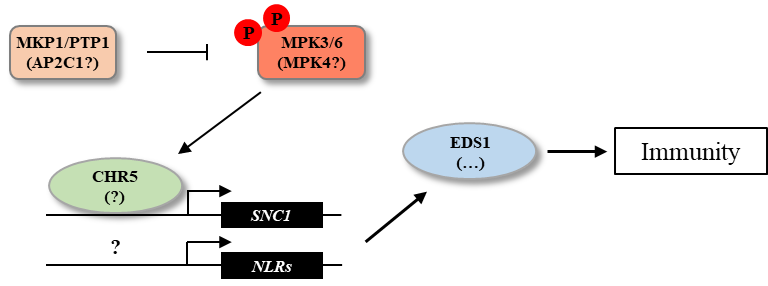
In a research article published in Scientific Reports, researchers from the STRESS team at IPS2 have shown through genetic approaches that the chromatin remodeling factor 5 (CHR5) acts downstream of MPK3/6 to promote the expression of SNC1. The authors also showed that, while CHR5 does not regulate the abundance or activity of MPK3/6, the combination of autoimmune gain-of-function mutants for MPK3 and SNC1 leads to a strong synergistic effect. Overall, the results obtained identify a new MPK3/6-CHR5-SNC1 signaling module and thus contribute to a better understanding of the links between PTI and ETI.
16/06/2026