- Presentation
- Research
- REGARN : Regulatory non-coding RNAs in root plasticity
- ChromD : Chromosome Dynamics
- SILAB : Signaling pathways regulating Legume root system Architecture through Beneficial bacteria
- Qlab : Plant Quantitative Genomics and Epigenomics
- FLOCAD : Flower and Carpel Development
- CCARS : Climate Change & Redox Signaling
- STRESS : Stress signaling
- MetaboActions : Signaling, regulation and metabolic interactions
- DPHYS : Department Physiology and signaling
- GDYNPATH: Genome Dynamics and Pathogen Resistance
- SYMUNITY: Symbiosis and Immunity
- OGE: Organellar gene expression
- GNet : Genomic Networks
- GUILLOTIN Lab
- Teaching
- Platforms
- Databases


3D genome reorganization and symbiotic nodulation
Three-dimensional genome reorganization enables cytokinin activation of symbiotic nodulation
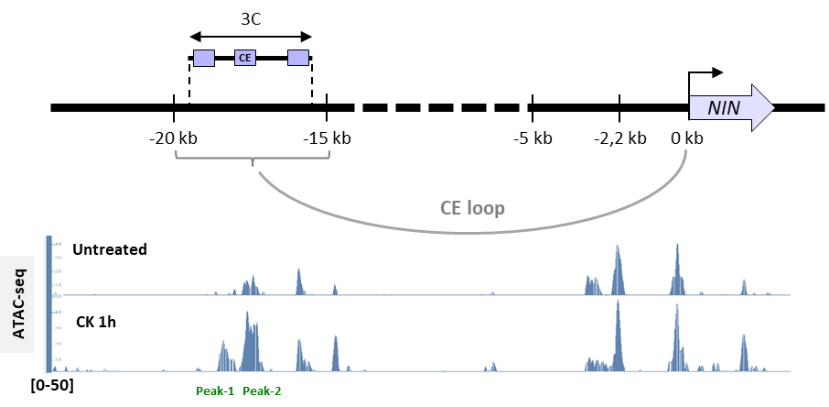
Legumes establish symbiotic interactions with soil-dwelling rhizobial bacteria, leading to the formation of nitrogen-fixing root nodules. This process requires extensive transcriptional reprogramming, which is associated with dynamic changes in DNA methylation and histone modifications. However, the role of three-dimensional (3D) genome architecture in symbiosis remains largely unexplored. In a new collaborative study published in Plant Communications between the teams of Florian Frugier (SILEG) and Moussa Benhamed (ChromD) at IPS2, we revealed using High-throughput Chromosome Conformation Capture (Hi-C), that the 3D chromatin landscape undergoes major reorganizations in nitrogen-fixing symbiotic nodules compared with non-symbiotic roots and non-nitrogen-fixing nodules. These changes involve alterations in A / B compartmentalization and the establishment of enhancer-promoter loops linked to the symbiotic program. Strikingly, we identified a long-range chromatin loop bridging a 15 kb distal enhancer to the proximal promoter of the NODULE INCEPTION (NIN) gene, a master regulator of nodulation. This enhancer region contains multiple putative cytokinin (CK) response elements, and the CK-dependent induction of NIN in roots is associated with this enhancer-promoter interaction. Moreover, we demonstrated that the CK signaling transcription factor RESPONSE REGULATOR B3 (RRB3) binds specifically to this distal enhancer region and participates in forming enhancer-promoter looping. Altogether, these results uncovered a critical role for 3D chromatin reorganization in regulating gene expression during the legume-rhizobium symbiosis, highlighting a regulatory mechanism through which hormonal signaling shapes genome architecture and modulates NIN activation via long-range chromatin looping.
23/07/2026