- Presentation
- Research
- REGARN : Regulatory non-coding RNAs in root plasticity
- ChromD : Chromosome Dynamics
- SILAB : Signaling pathways regulating Legume root system Architecture through Beneficial bacteria
- Qlab : Plant Quantitative Genomics and Epigenomics
- FLOCAD : Flower and Carpel Development
- CCARS : Climate Change & Redox Signaling
- STRESS : Stress signaling
- MetaboActions : Signaling, regulation and metabolic interactions
- DPHYS : Department Physiology and signaling
- GDYNPATH: Genome Dynamics and Pathogen Resistance
- SYMUNITY: Symbiosis and Immunity
- OGE: Organellar gene expression
- GNet : Genomic Networks
- GUILLOTIN Lab
- Teaching
- Platforms
- Databases


Beware of misinterpretations in -omics analyses!
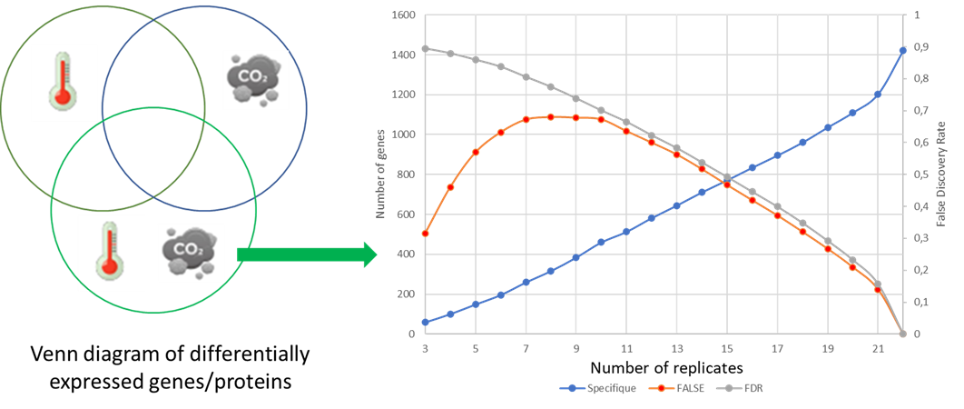
A very large proportion of false specific DEG when using few replicates and Venn Diagramms.
Omics analyses represent a crucial step in the search for condition-specific events and often rely on Venn diagrams. In stress experiments for example, the presence of differentially expressed genes exclusively under combined stress conditions is frequently interpreted as evidence of non-additive effects: the effect of combined stresses would differ from the sum of the effects of individual stresses.
In an article published in Nature Plants (Ferraro et al. 2026), to test the relevance of this line of reasoning, the Gnet team and the OGE team with several collaborators at IPS2, and the POPS, PAPPSO and Phenoscope platforms, generated a transcriptomic and proteomic dataset under a control condition, two single stresses, and the combination of both stresses, with 22 biological replicates.
Analysing this dataset, Ferraro et al. demonstrate that identifying specific responses using Venn diagrams generates many false positives. This is explained by the low statistical power inherent in most omics studies that use too few replicates (typically around 3).
Ferraro et al. 2026 thus highlights the need to interpret any claims about the specificity of such omics datasets with caution, and advocate for improvements in statistical modeling to avoid misleading biological interpretations.
22/06/2026