- Presentation
- Research
- REGARN : Regulatory non-coding RNAs in root plasticity
- ChromD : Chromosome Dynamics
- SILAB : Signaling pathways regulating Legume root system Architecture through Beneficial bacteria
- Qlab : Plant Quantitative Genomics and Epigenomics
- FLOCAD : Flower and Carpel Development
- CCARS : Climate Change & Redox Signaling
- STRESS : Stress signaling
- MetaboActions : Signaling, regulation and metabolic interactions
- DPHYS : Department Physiology and signaling
- GDYNPATH: Genome Dynamics and Pathogen Resistance
- SYMUNITY: Symbiosis and Immunity
- OGE: Organellar gene expression
- GNet : Genomic Networks
- GUILLOTIN Lab
- Teaching
- Platforms
- Databases


YAB5: a master switch for pollinator attraction in melon flowers
The YABBY transcription factor YAB5 integrates nectary development, nectar secretion and petal signals to attract pollinators in melon
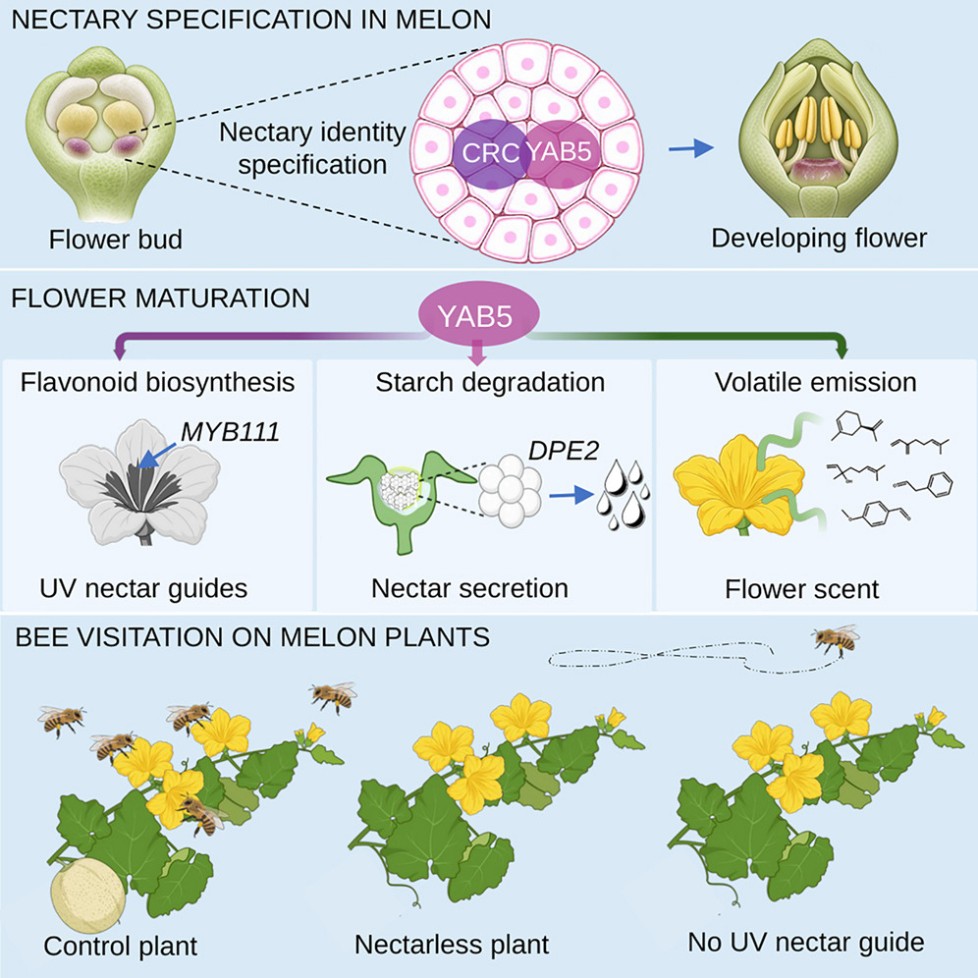
Animal pollnators underpin biodiversity and global agriculture, yet the molecular innovations that enabled flowers to evolve coordinated rewards and petal signals to attract pollinators remain poorly understood. In a new article published in Cell, the FLOCAD team identified nectarless1 (nls1) encoding the YABBY-family transcription factor YAB5, as a central integrator of pollinator- attracting traits through phenotyping melon genetic diversity. YAB5 interacts with CRABS CLAW (CRC) during nectary initiation to specify nectary identity by repressing alternative floral organ fates. As flowers mature, YAB5 coordinates the nectary metabolic reprogramming required for nectar secretion while simultaneously regulating petal polarity, expansion, and flower opening. YAB5 also controls petal flavonoid accumulation and volatile terpene emission, shaping visual and chemical cues for pollinators. Together, these findings reveal a molecular mechanism that synchronizes floral development, metabolism, and ecological function underlying plant–pollinator mutualism.