- Presentation
- Research
- REGARN : Regulatory non-coding RNAs in root plasticity
- ChromD : Chromosome Dynamics
- SILAB : Signaling pathways regulating Legume root system Architecture through Beneficial bacteria
- Qlab : Plant Quantitative Genomics and Epigenomics
- FLOCAD : Flower and Carpel Development
- CCARS : Climate Change & Redox Signaling
- STRESS : Stress signaling
- MetaboActions : Signaling, regulation and metabolic interactions
- DPHYS : Department Physiology and signaling
- GDYNPATH: Genome Dynamics and Pathogen Resistance
- SYMUNITY: Symbiosis and Immunity
- OGE: Organellar gene expression
- GNet : Genomic Networks
- GUILLOTIN Lab
- Teaching
- Platforms
- Databases


Transposons at the heart of cellular networks
A functional atlas reveals the diversity of transposon products and their interactions with cellular networks in Arabidopsis thaliana
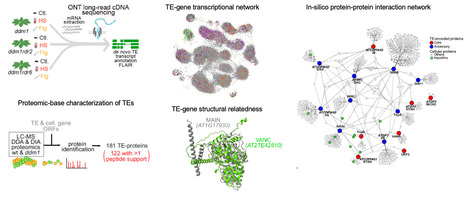
In a study published in Nature Communications, scientists from the QLAB team at the Paris-Saclay Institute of Plant Sciences (IPS2) conducted a large-scale exploration of transposon-derived products and their interactions with cellular networks in Arabidopsis thaliana.
Transposons are DNA sequences capable of replicating within genomes thanks to factors they encode themselves. However, the diversity of their RNAs and proteins, as well as their interactions with the host cell, remain poorly characterized. By combining long- and short-read sequencing, regulatory network analyses, high-depth proteomics, and structural predictions, the researchers established a functional atlas of transposon products. Their results show that the expression of these elements is integrated into the cell’s regulatory networks and depends in particular on DNA methylation and the action of transcription factors. More than a hundred transposon-derived proteins have also been identified with a high degree of confidence. Structural analyses reveal a wide variety of structures and potential interactions with plant proteins. They also highlight similarities between certain transposon proteins and cellular proteins, suggesting potential new cases of transposon domestication during evolution.
Overall, this research demonstrates that transposons are active components of cellular networks and a potential source of genomic innovation.
25/09/2026