- Presentation
- Research
- REGARN : Regulatory non-coding RNAs in root plasticity
- ChromD : Chromosome Dynamics
- SILAB : Signaling pathways regulating Legume root system Architecture through Beneficial bacteria
- Qlab : Plant Quantitative Genomics and Epigenomics
- FLOCAD : Flower and Carpel Development
- CCARS : Climate Change & Redox Signaling
- STRESS : Stress signaling
- MetaboActions : Signaling, regulation and metabolic interactions
- DPHYS : Department Physiology and signaling
- GDYNPATH: Genome Dynamics and Pathogen Resistance
- SYMUNITY: Symbiosis and Immunity
- OGE: Organellar gene expression
- GNet : Genomic Networks
- GUILLOTIN Lab
- Teaching
- Platforms
- Databases


Tools and mutants’ diversity
Mutant’s engineering in crops, examples of tools complementary!
Drawing on 3 recent publications in which the EPITRANS platform was involved, we aim to illustrate how different tools complement one another in generating mutants in model and crop plants. TILLING mutants, CRISPR/Cas9-edited mutants, transposon-induced insertion mutants, and mutants silenced by VIGS and/or miRNAs all have their advantages and disadvantages, but they all serve the same purpose: to create genetic variability in order to broaden natural diversity and address questions in both basic and applied research. Thanks to this range of tools, researchers have one or more options to choose from, depending on the species, variety, resources, tools, and expertise available.
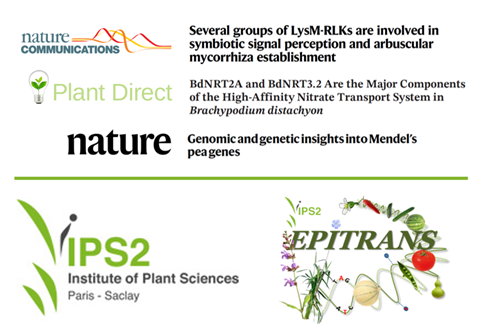
In an article published in Nature Communications (Ding et al., Nat Commun. 2025), colleagues from LIPME in Toulouse studied a class of LysM-RLK receptors, the as yet poorly characterised LYR-IB group, to understand their role in the perception of symbiotic signals and in the establishment of arbuscular mycorrhizal (AM) symbiosis. This study was conducted on several plant species using ‘loss-of-function’ mutants. They identified a group of LysM-RLKs that bind directly to the various types of signals emitted by the arbuscular mycorrhizal fungi, and that play an important role in signalling and in the establishment of AM in angiosperms. The different phenotypes observed also show varying levels of LYR-IA and LYR-IB redundancy in monocots compared to dicots.
In a Plant Direct publication (David et al, Plant Direct. 2025), colleagues from IJPB in Versailles investigated the role of two transporters involved in the high-affinity nitrate transport system (HATS), which is active under nitrate-deficient soil conditions. This study was carried out on Brachypodium distachyon, a model plant used for C3 cereals. Mutants of these two transporters were generated using TILLING and miRNA. Using various approaches, they were able to demonstrate that the two transporters studied (BdNRT2A and BdNRT3.2) are the key players in the HATS system in Brachypodium (Bd21-3) to enable an optimal growth under low-nitrogen conditions.
In a Nature article (Feng et al., Nature 2025), colleagues at the John Innes Centre in Norwich (UK) have investigated the genetic basis of the seven traits described by Mendel in pea. Using a variety of genetic approaches, new alleles have been discovered for four of the previously characterised genes, and the causal mutations for the remaining three traits have been identified, sometimes involving several regions and/or genes. This study completes the story of the traits observed by Mendel to explain the laws of genetics at the end of the 19th century.
From mutagenesis to CRISPR, via TILLING, the EPITRANS platform provides the scientific community with tools, expertise and valuable genetic resources across more than 13 species, the majority of which are cultivated. In the three publications highlighted here, collections of mutants generated by mutagenesis using EMS (for pea, Dalmais et al., Genome Biol. 2008) and sodium azide (for Brachypodium, Dalmais et al., PLoS One 2013) were used to generate the mutants of interest by TILLING.
20/11/2026